global

Maps / 3 weeks ago
Here is what the world’s population map could look like in 2100
New projections from the UN Population Division show that population growth will be heavily concentrated in Africa and parts of Asia, while Europe, the Americas and Oceania face slowdowns or long-term declines. By the end of this century, the global population will look dramatically different from the world we know today. New projections from the UN Population Division show that population growth will be heavily concentrated in Africa and parts of Asia, while Europe, the Americas and Oceania face slowdowns or long-term declines.

World / 3 weeks ago
Half of global GDP comes from just 3.6% of the world — new data shows the imbalance
Only 3.6% of the world’s land area generates half of global GDP, a striking reminder of how unevenly economic power is distributed across the planet. Only 3.6% of the world’s land area generates half of global GDP, a striking reminder of how unevenly economic power is distributed across the planet. The regions highlighted, including parts of the United States, Western Europe, Japan, China’s major coastal hubs, and South Korea, represent the world’s most concentrated engines of productivity.

Business / 7 weeks ago
China dominates global apple market
The world’s appetite for apples continues to grow, and at the centre of this fruity boom is China. According to a recent graphic showing the world’s largest apple producers, China alone is estimated to cultivate around 48 million metric tonnes of apples in 2024, by far the largest single-country output. That figure is backed by the United States Department of Agriculture Foreign Agricultural Service (USDA FAS), which, in its “China: Fresh Deciduous Fruit Annual” report, estimates China’s apple production at approximately 48 MMT for the marketing year 2024/25.

Environment / 8 weeks ago
Countries with the highest testosterone levels
A new visual by World Visualized highlights the countries with the highest average testosterone levels, measured in nanograms per deciliter (ng/dl). The data reveals some surprising global trends, with Uzbekistan leading the world at 773 ng/dl, followed closely by Croatia (752 ng/dl) and Cameroon (731 ng/dl).
World / 9 weeks ago
What the world’s gun-per-capita map really shows
The global map of civilian firearm ownership reveals that a few nations hold the overwhelming majority of the world’s guns. According to the Small Arms Survey, civilians possessed an estimated 857 million firearms globally as of 2024, representing roughly 85% of all small arms in circulation.

Business / 9 weeks ago
The future of the global economy: How emerging nations are working to redefine power by 2075
By 2075, the global balance of economic power could look entirely different, with emerging nations from Asia, Africa, and Latin America taking centre stage. According to Goldman Sachs’ long-term projections, the world’s largest economies will no longer be dominated by Western powers. Instead, countries like China, India, Indonesia, and Nigeria are expected to lead a multipolar global order defined by demographic strength, industrial expansion, and technological adoption.

World / 10 weeks ago
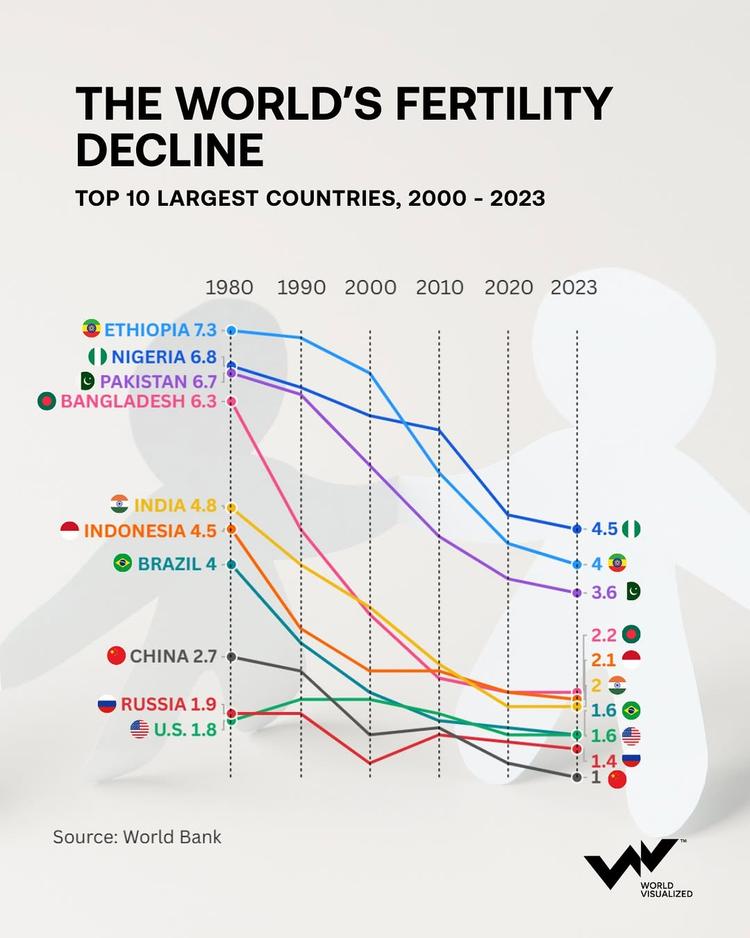
5 of the world’s 10 largest countries now below replacement-level fertility
Across much of the world, people are having fewer children than ever before. A new visual from World Visualised, using World Bank data, shows a striking pattern: between 2000 and 2023, fertility rates in the ten largest countries have fallen sharply, and in five of them, they’ve dropped below the replacement level of 2.1 births per woman. According to the data, this includes China, Russia, the United States, Brazil, and Indonesia, nations that together make up nearly half of the world’s population. Meanwhile, countries like Nigeria, Ethiopia, Pakistan, Bangladesh, and India have also seen steady declines, though their rates remain above replacement for now.
World / 14 weeks ago
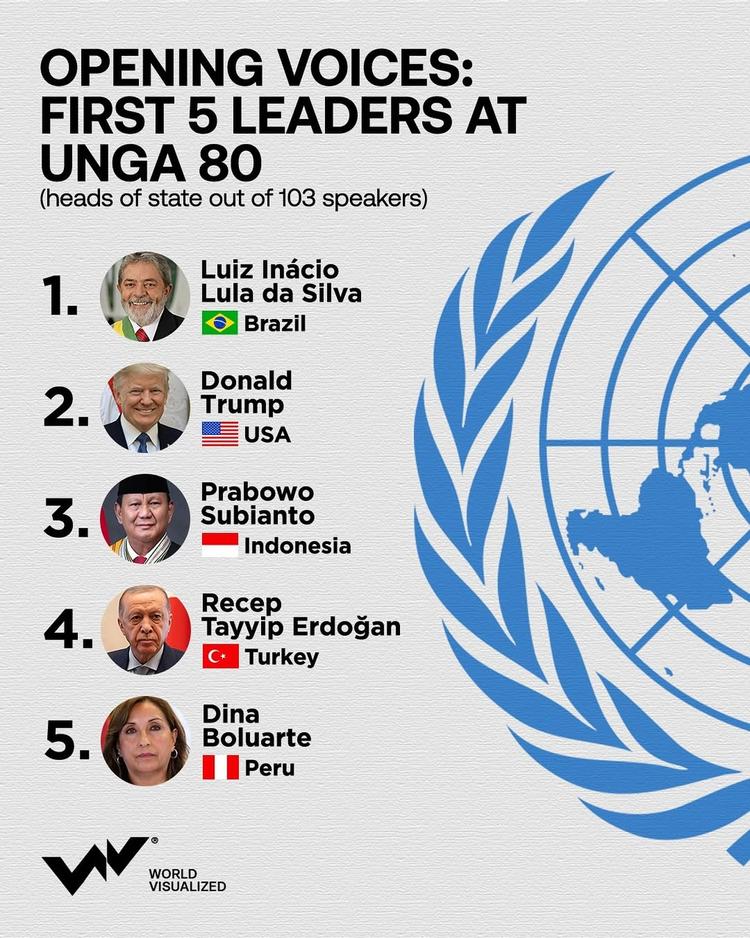
'Opening Voices' at UNGA 80: Who speaks first?
The United Nations General Assembly enters its 80th session in September 2025 under the banner "Better together: 80 years and more for peace, development and human rights.” The High-Level General Debate begins Tuesday, September 23, where world leaders deliver keynote addresses.

Environment / 34 weeks ago